How to Analyse Race Replays Like a Pro: Eleven Essential Factors to Consider
Why Watching Race Replays Is One of the Biggest Edges a Punter Can Have
Hi guys,
Watching race replays is one of the most important — and most underused — skills in horse racing betting.
Results, form figures and even comments in the paper only ever tell part of the story. Replays tell you what actually happened. They show you how a race was run, where a horse was disadvantaged, and why a finishing position can often be misleading.
In my opinion, punters don’t spend nearly enough time on post-race analysis, yet it plays a huge role in long-term profitability. Most value opportunities don’t come from spotting obvious winners — they come from spotting horses that ran better than the bare result suggests.
Below are 11 key things I always look for when watching race replays, along with simple, practical takeaways you can apply straight away.
1. How the Horse Jumped from the Stalls
A slow start can ruin a horse’s chance before the race has even begun — especially in sprint races.
Personally, I completely avoid backing horses in 5f and 6f races if they regularly miss the break. Over those trips, there just isn’t enough time to recover lost ground. Some horses consistently break slowly and finish late, while others need to be on or near the lead to show their best.
The key is separating one-off mistakes from bad habits.
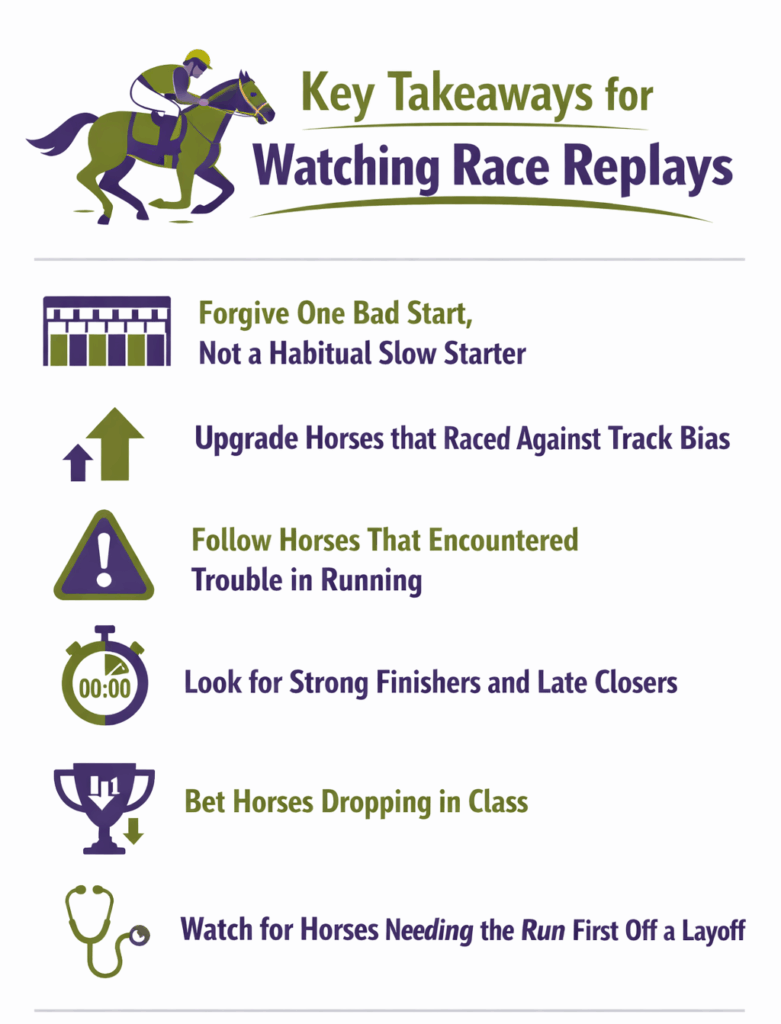
Key takeaway: If a horse missed the break as a one-off but still finished strongly, it can offer value next time — particularly if better drawn, in a smaller field, or over a slightly longer trip.
2. Early Positioning and Track Bias
Not all tracks are created equal.
Some strongly favour horses that race prominently, while others suit horses that are held up and finish late. Understanding this is crucial when reviewing replays.
If a horse raced against the track bias but still ran well, that effort is often worth upgrading. Likewise, horses that benefited from the perfect setup can be overrated by the market next time.
I’m always asking: Did this horse get the run of the race, or did it do well despite the circumstances?
Key takeaway: Horses that perform well despite an unfavourable draw, pace or track bias often improve significantly next time under fairer conditions — sometimes at much bigger odds.
3. Trouble in Running
This is one of the biggest sources of hidden value.
Horses can lose races through:
being boxed in
getting blocked at a crucial stage
being forced wide around bends
clipping heels or being hampered
stumbling or losing momentum at the wrong time
These things rarely show up properly in form figures — but they are crystal clear on replays.
Many of the winners I tip come straight from my Tracker, added after spotting exactly this sort of bad luck.
Key takeaway: If a horse was unlucky but still finished its race off well, it’s often worth following — especially if it gets a cleaner run next time.
4. How the Horse Travelled
I pay close attention to how a horse moves through a race.
Did it travel smoothly on the bridle, or was it being pushed along early? Did it respond when pressure was applied? Did it show a bit of fight?
You’ll often see me write that a horse “showed a good fighting attitude” — that’s not accidental. Horses that dig in under pressure are usually reliable types.
On the flip side, horses that look outpaced but keep staying on often want a longer trip.
Key takeaway:
Smooth travellers who respond well under pressure are usually solid bets
Horses that are outpaced but stay on strongly are often worth stepping up in distance — pedigree can be a big clue here
5. Energy Use and Mid-Race Moves
Some horses lose races not because they aren’t good enough — but because they use too much energy at the wrong time.
You’ll often see horses:
going too hard early
making a big mid-race move
racing wide and doing extra work
These efforts can leave nothing left at the finish. I’ll forgive this once — but not if it becomes a habit.
I also pay close attention to horses drawn wide who have to burn energy early just to get into position. Those horses often perform much better when drawn low next time.
Key takeaway: Look for horses that finished strongly after an inefficient run — especially those that had to work harder than ideal early on.
6. Jockey Tactics and Riding Style
Not every ride is equal.
Some jockeys are positive and decisive, others more patient. Sometimes a horse is given a quiet ride simply to gain experience or protect its mark.
A horse that finishes well without ever getting into the race can be very interesting next time — particularly if there’s a jockey change.
I always dig into trainer-jockey combinations and course records. If the partnership has a poor record at a track, I’m cautious — even if I like the horse.
Key takeaway: A strong finisher off a quiet ride can be a big betting opportunity next time, especially with a better jockey booking or useful weight taken off.
7. Strength of Opposition and Class
A finishing position on its own can be misleading.
A horse finishing fifth in a strong race can run better than a winner of a weak one. This is where you start comparing horses at the weights and looking beyond simple results.
It’s also where class drops become very important. Horses often become extremely competitive when dropped into weaker company.
Key takeaway: Upgrade horses that hold their own against better opposition — they can be very dangerous when dropped in class next time.
8. Ground Conditions
Some horses are ground-dependent — simple as that.
A poor run on unsuitable ground is often one to forgive, especially if the horse has clear form under different conditions.
This is another area where replays help, as you can often see a horse struggling to move or travel properly.
Key takeaway: Don’t write off horses that underperform on the wrong ground — they can bounce back quickly when conditions suit.
9. Finishing Effort
Always watch how a horse finishes — not just where it finishes.
Did it weaken when pressure was applied, or did it keep finding more? Horses that hit the line strongly often want:
a stronger pace
a longer trip
or a better tactical setup
Key takeaway: Strong finishers are often worth following, particularly in bigger fields or over longer distances.
10. Greenness and Inexperience
Young or lightly raced horses often “run green” — meaning they lack experience and don’t yet know how to race properly.
They may:
wander under pressure
fail to respond immediately
lose focus at crucial moments
What matters is how much ability they show despite this. A horse that runs green but still finishes well can improve dramatically next time.
You’ll often see me say that young horses can improve 10–20lb or more from one run to the next — that’s based on watching this happen time and time again.
Key takeaway: Inexperienced horses that show promise despite mistakes often make big jumps forward with racing.
11. Fitness and “Needing the Run”
Fitness is a huge angle — and one many punters overlook.
Horses returning from a break often:
race prominently before fading
get an easy ride
blow hard after the race
Trainers will sometimes tell you straight that a horse “needed the run” — and some horses have a clear pattern of improving second time out.
These are exactly the sort of horses I like to track.
Key takeaway: Horses that fade late after a break, or are given gentle introductions, often improve significantly next time — sometimes before the market fully catches on.
Final Thoughts
By watching race replays properly, you start to see races very differently.
You stop betting on finishing positions and start betting on performance, context, and misunderstood runs. That’s where value lives.
I don’t know a single professional punter who doesn’t use replay analysis as part of their edge. For me, it’s just one piece of the puzzle — alongside form, pace, markets, ratings and trainer insight — but it’s often the deciding factor.
Most of my selections come from what I’ve visually observed, not just what’s written on paper. Once I’ve identified a horse that I believe the market has underestimated, I then decide whether the price represents value. If it does, I’ll post a tip.
Hi, I’m 56 and have been tipping profitably year after year since 2012. I created this "ethical" website to help punters like you make a little extra on your bets. My approach focuses on finding and highlighting each-way value, then guiding you to the bookmakers offering the best prices or paying extra places on the race.
While the site has no affiliations with any bookmakers (and I don’t receive money from them), regularly taking advantage of their offers can seriously boost your profits over time.
What you’ll find here are well-researched tips, backed by solid reasoning and clear logic behind every selection. If you’d like to learn more about me, just click on the "About" section on the Home Page.