Bankroll Management: The Skill That Keeps You Alive Long Enough To Win
Hi guys,
If I could only teach one thing to a new punter, it wouldn’t be how to read sectionals.
It wouldn’t be how to break down a pace map.
It wouldn’t even be how to spot a 12/1 shot that should be 6/1.
It would be this:
Protect your bankroll.
Because without that, none of the rest matters.
You can be brilliant at analysing races. You can consistently find value. You can even beat the Starting Price (SP) regularly.
But if your staking is reckless, you’ll go broke before your edge has time to show.
Bankroll management isn’t exciting.
It doesn’t get applause.
It doesn’t get retweets.
But it is the difference between:
A punter who blows up every six months
And one who’s still operating five years from now
Let’s break it down properly.
Step One: Separate Your Bankroll From Your Life
Before percentages and units, we start here.
Your betting bankroll must be:
Completely separate from your bills
Completely separate from savings
Completely separate from emergency money
It is not “what’s left in my current account.”
It is investment capital.
If losing it would damage your lifestyle or cause genuine stress, it’s too big.
When fear enters staking decisions, discipline disappears.
And once discipline goes, bankroll destruction follows quickly.
Why 1%–3% Per Bet Is Not Random Advice
You’ll often hear people say:
“Bet 1% to 3% of your bankroll per bet.”
Most punters accept it without understanding why.
It’s not arbitrary.
It’s about survival.
Horse racing has brutal variance. This means in horse racing, losing spells are part of the game — even if you’re good.
If you’re backing 8/1, 10/1 or 14/1 shots — especially in handicaps — losing runs are inevitable.
Even if you’re good.
Even if you’re profitable.
A 15% strike rate means you win roughly 1 in 6–7 bets.
That also means you can easily hit:
10 losers in a row
15 losers in a row
20 losers in a row
And still be completely fine long term.
Now imagine you’re staking 10% of your bank per bet.
Ten losers in a row doesn’t just hurt.
It destroys you.
This is called risk of ruin — and it wipes out more good punters than bad analysis ever does.
The Percentage Method (The Gold Standard)
The simplest and most effective system for most punters is this:
Bet a fixed percentage of your current bankroll each time.
Example:
Bankroll = £1,000 1% stake = £10 2% stake = £20
If your bank grows to £1,200, 1% becomes £12.
If it drops to £800, 1% becomes £8.
It automatically:
Increases during winning runs
Decreases during losing runs
It protects you from yourself.
Why Percentage Staking Never Hits Zero
This is crucial.
When you bet a percentage of your bankroll, you are not staking a fixed amount.
If you start with £1,000 and bet 5%, that’s £50.
After a loss, your bank is £950 — so 5% is now £47.50.
After another loss, it’s 5% of £902.50.
Your stake keeps shrinking.
Your losses slow down.
Your bankroll decays gradually.
It never truly hits £0.
This is called exponential decay.
It’s completely different from flat betting.
If you flat bet £50 from a £1,000 bank, you are wiped out after exactly 20 consecutive losses.
With percentage staking, you are still alive after 20 losses.
And survival is everything.
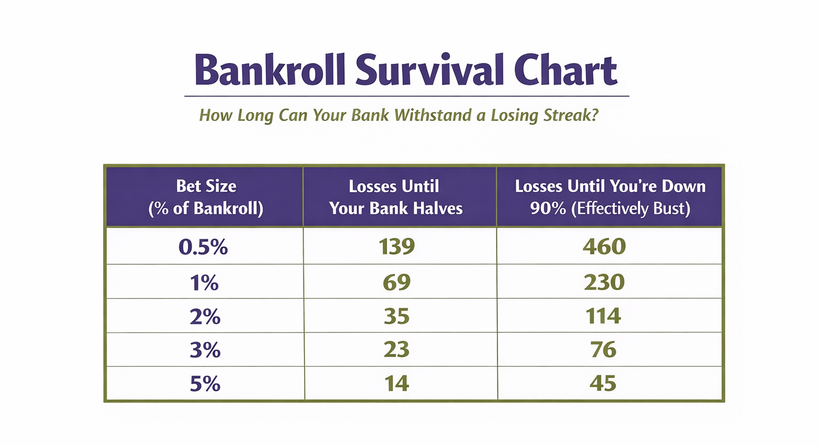
This visual 👆👆 shows:
Losses until your bank halves
Losses until you’re down 90% (effectively bust)
It demonstrates how quickly larger betting percentages damage you — and why 5% is far more aggressive than most people realise.
The goal of bankroll management isn’t to avoid losing runs.
It’s to survive them.
What The Numbers Really Tell Us
Look at the difference:
At 1% staking, it takes roughly 69 consecutive losses to halve your bank.
At 5%, it takes around 14.
That’s enormous.
In value betting, long losing sequences are normal.
At 5%, you’ll feel broken long before your edge has time to play out.
At 1%–2%, you stay emotionally and financially stable.
That stability is your edge.
Units: Keeping Things Structured
Instead of recalculating percentages constantly, define:
1 Unit = 1% of bankroll
Then stake in units:
1 unit = standard value bet
2 units = strong overlay (you’re confident you have a strong edge)
0.5 unit = smaller opinion
But here’s the rule:
Do not change unit size after every race.
Only adjust:
Monthly
After 50–100 bets
Or if bankroll changes by 20%+
If you change your staking because of how you feel after one race — whether it’s frustration after a loss or excitement after a win — you slowly drift away from your plan. And once you drift from your plan, you’re no longer betting with discipline. You’re reacting.
Confidence vs Value (They Are Not The Same)
This is where staking goes wrong.
A horse can look very likely to win.
But be terrible value.
And a horse can look unlikely.
But be massively overpriced.
You stake based on value, not just confidence.
If you price a horse at 5/1 and it’s 10/1 in the market, that’s a serious overlay.
If a horse is 2/1 but you believe it should be Evens, that’s value too.
Value drives long-term profit.
Confidence alone does not.
Losing Runs Are Inevitable
Every serious punter goes through losing runs.
It doesn’t matter how good you are.
It doesn’t matter how sharp your analysis is.
If you’re backing value at decent prices, you will hit spells where nothing seems to go right.
You’ll have:
Photo finishes go against you
Horses caught wide
Big-priced selections finish 4th
Favourites beat you late
That isn’t failure.
That’s variance.
The problem isn’t the losing run.
The problem is how you react to it.
This is why bankroll management matters.
It gives you room to breathe when results aren’t falling your way.
You should have a simple rule, for example:
“If my bankroll drops by 20–25%, I pause for 48 hours and review.”
Ask yourself:
Am I still getting value?
Am I still beating the prices?
Or has my process slipped?
Bankroll management protects you during bad runs.
It keeps you alive long enough for the good runs to come back.
Hi, I’m 56 and have been tipping profitably year after year since 2012. I created this "ethical" website to help punters like you make a little extra on your bets. My approach focuses on finding and highlighting each-way value, then guiding you to the bookmakers offering the best prices or paying extra places on the race.
While the site has no affiliations with any bookmakers (and I don’t receive money from them), regularly taking advantage of their offers can seriously boost your profits over time.
What you’ll find here are well-researched tips, backed by solid reasoning and clear logic behind every selection. If you’d like to learn more about me, just click on the "About" section on the Home Page.